
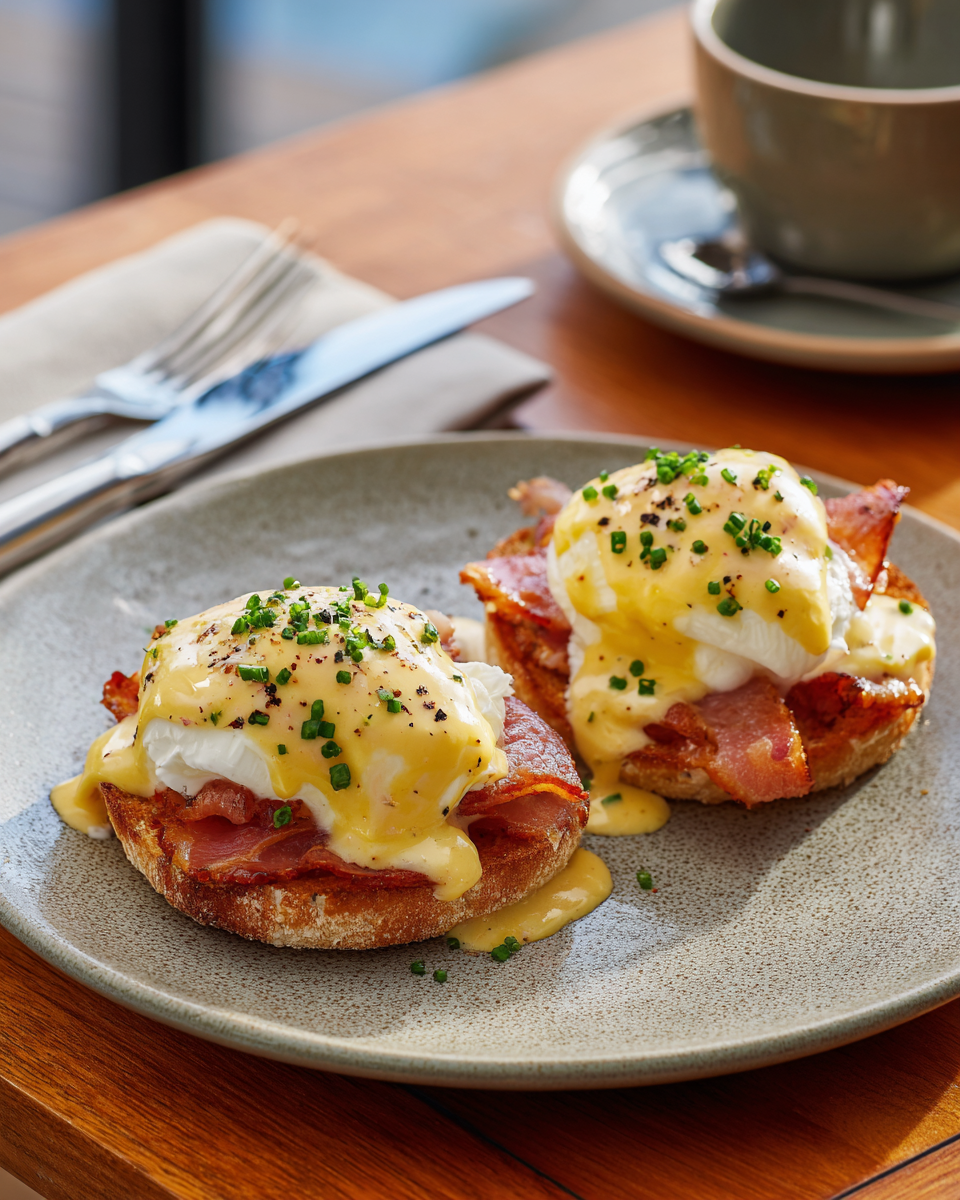
The base decides everything that follows
Eggs benedict is a structural dish. The bread holds bacon, holds eggs, holds hollandaise. If the bread fails, the dish fails, no matter how good the rest of the components are.
An English muffin is the orthodoxy and the orthodoxy is right. The nooks hold sauce, the crumb stays structural under the weight of two poached eggs and a generous spoon of hollandaise, and the toasted exterior gives the bite some integrity. The customer cuts in, the yolk runs into the muffin, and the muffin holds.
Sourdough is acceptable if the slice is right. A thick cut, properly toasted, dense enough to take the load. A thin slice of soft white sourdough turns into mush within ninety seconds and the dish arrives at the table already half-collapsed. Brioche is wrong: too sweet, too soft, turns the savoury balance into a confused mess. White toast is a cost-cutting move and customers notice.
The English muffin is the dish's heritage component. Eggs benedict was created at the Waldorf Hotel in New York in 1894 (or the Delmonico's in 1860, depending on which historian you trust) and the muffin was the base in both stories. Choose another bread by all means, but know what you are losing when you do.
How the bacon is cooked decides whether the dish is balanced
The bacon question splits two ways. First, bacon or ham (or salmon or spinach). Second, how the chosen protein is cooked.
In the Australian cafe context, streaky middle bacon has won. It is what customers expect. Ham appears occasionally on the more traditional menus and works perfectly well, but bacon is the default and it is the default for a reason: the salty crisp of well-rendered bacon is a foil to the rich softness of egg yolk and butter sauce. Without that contrast, the dish reads as a single note of richness, and customers leave the table feeling heavier than they wanted to.
Cooking the bacon is the moment cafes lose the dish. Pan-fried streaky bacon at service is hit-or-miss: under the lights of a busy Saturday, half the rashers come out chewy and half come out burnt. The fix is to oven-bake the bacon in batches. Lay rashers flat on lined trays, bake at 180 degrees Celsius for twelve to fifteen minutes until evenly crisp, drain on paper, and hold warm. Every rasher comes out the same. Every plate gets the same dish.
This is also the difference between a kitchen that has thought about the dish and one that has not.
A poached egg is a three-minute commitment
The poached egg is the easiest component to ruin and the easiest component to perfect. The technique is settled: gentle simmer, splash of vinegar, fresh egg cracked into a small dish first and slid in (not dropped from height), three minutes for a fresh egg, four if it has been in the fridge a while.
The whites set on the outside. The yolk stays liquid. The customer cuts in, the yolk runs, and the dish performs. A hard yolk on eggs benedict is a wasted dish. The customer ordered it for the runny yolk. If the yolk does not run, the dish is broken, no matter how good everything else is.
Some cafes batch-poach eggs in advance to manage service speed. This works if the eggs are held in iced water and reheated gently to order, but it adds a step that easily slips out of consistency under pressure. To-order poaching, with a clear three-minute timer, gives the most reliable result.
The sauce is what customers remember
Hollandaise is the dish's signature. It is also the component most likely to break, and the component that most often determines whether a customer rates the dish a 6 or a 9.
From-scratch hollandaise is the romance of the dish. Egg yolk whisked over a bain-marie, butter added slowly to form an emulsion, lemon juice and salt to balance. When it is good, it is glossy, lemon-bright, just thick enough to coat the back of a spoon, and slightly warm so it lifts as it hits the egg.
From-scratch hollandaise also breaks under service pressure. The emulsion drops if the temperature climbs too high. It separates if it sits too long without being whisked. By 11am on a busy Saturday, fresh hollandaise made at 7am is already a food safety question. This is why high-quality prepared hollandaise has become the default in many serious cafes: the consistency wins over the romance.
Whichever route the kitchen takes, two things are non-negotiable. Hold the sauce at 62 degrees Celsius or above in a warming station, and refresh the batch every four hours. Hollandaise held at room temperature is a fast route to a sick customer.
The portion size of hollandaise matters more than people think. A generous spoon (around 80ml per portion) makes the dish feel luxurious without becoming heavy. Drown the dish in 150ml and customers stop being able to taste the egg, the bacon, or the bread. Underdose at 40ml and the sauce reads as garnish rather than centrepiece. Eighty millilitres is the number.
The best eggs benedict in Australia, in one sentence
A toasted English muffin, oven-baked streaky bacon held warm, two eggs poached to order at three minutes, eighty millilitres of glossy hollandaise held at 62 degrees and refreshed every four hours, finished with cracked black pepper and a few snipped chives.
That is it. There is no clever trick, no signature twist, no deconstructed reinterpretation that improves on the formula. The dish is a hundred and thirty years old and it has been refined by every brunch service since. Respect the formula and the dish takes care of itself. The version that loses its way is almost always the one that tries to be clever, swapping the muffin for sourdough or the ham for something fancy.
If you are running an Australian cafe and you are wondering whether to put eggs benedict on the menu, the answer is yes. The four decisions above are the test. Hold all four consistently and you have a dish customers will drive across town for. The decisions are not difficult, but they are deliberate, and the cafes that nail them are the ones building return custom on a single great plate.