
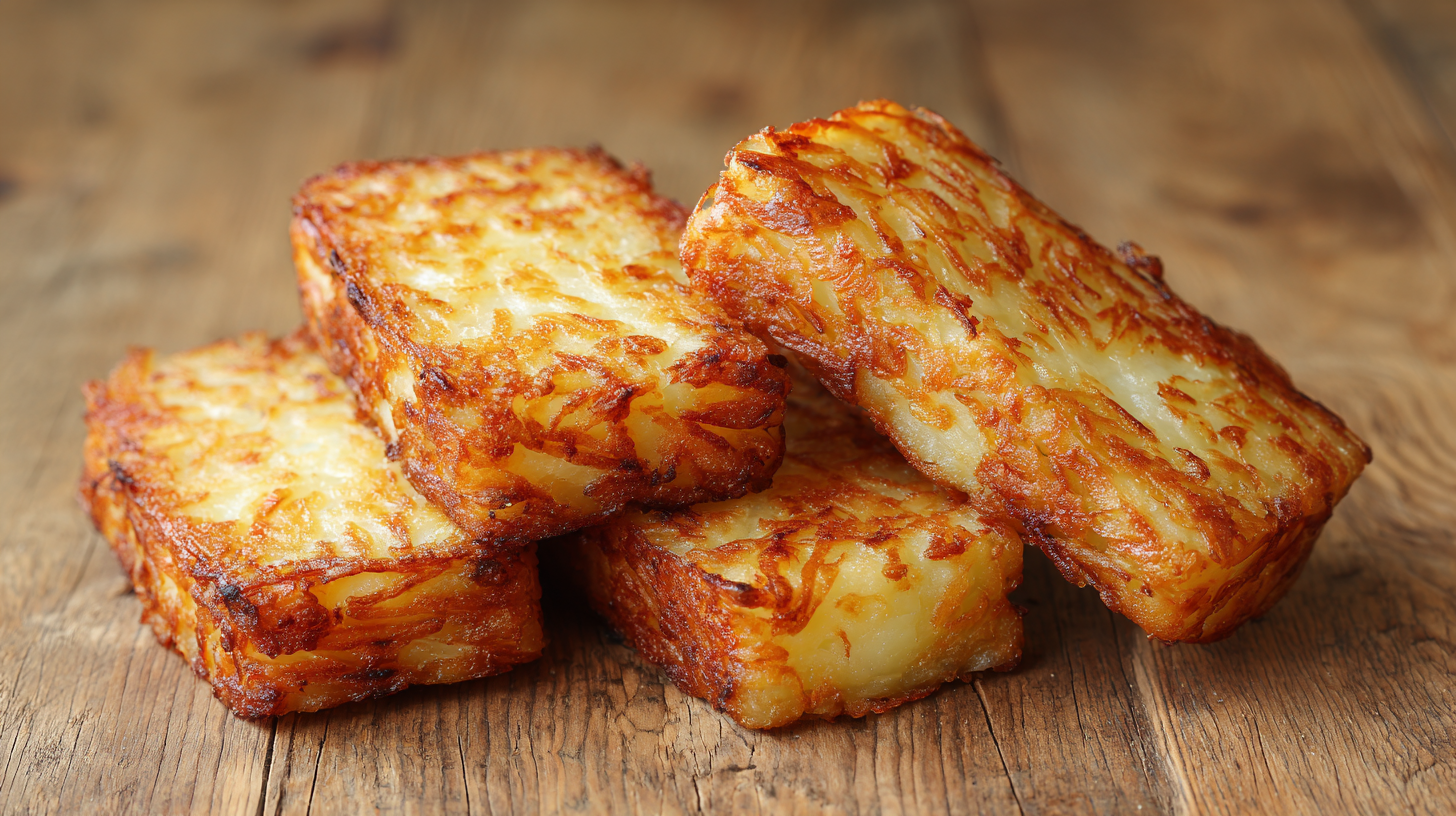
A small Swiss thing on the breakfast plate
The rösti began life as a farmer's breakfast in German-speaking Switzerland, somewhere between the late 1800s and early 1900s. The story is the kind every honest peasant dish has: leftover boiled potatoes from the night before, grated coarsely, pressed into a hot pan with a knob of butter, fried until the edges crackled. Eaten with whatever was around. Coffee. A piece of cheese. The remains of yesterday's sausage. Nothing fancy. Just good.
That is still the dish, more or less. What has changed is what it does on a modern cafe breakfast plate. In an Australian cafe, the rösti is the side that quietly lifts the plate from competent to memorable. It is the architectural element under the poached eggs, the crisp counterpoint to the soft bacon, the thing the fork goes back to when the plate is nearly done. It is the small piece of the breakfast that, weeks later, the customer remembers.
Bake first, fry to finish
The cafe rösti is made in two stages, and that two-stage cook is the whole game. The first stage is done in batch, the day before. The second is done in the fryer, to order, in the same time it takes the eggs to poach.
The method runs like this. Sebago potatoes (the starchy variety, not waxy) are coarsely grated. The grated potato is wrapped in a clean cloth or muslin and squeezed hard until most of the moisture is out. This is the step that defines the texture. The drier the grated potato, the crisper the finished brick. Many kitchens add a step here, salting the potato lightly and resting it in a colander for ten minutes before squeezing, which pulls out a little more water. It is worth doing.
The dried potato is then mixed with beaten egg, cornflour, plain or gluten-free flour, salt and white pepper. The mix is pressed firmly into rectangular silicone moulds or metal rings on a lined tray and baked at 180 degrees for fifteen to twenty minutes, until the surface is set and lightly golden. The bricks come out, cool completely, and can be slipped from the moulds clean. From here they hold three days refrigerated or freeze for longer, stacked between sheets of baking paper.
To order, the chilled brick is dusted lightly in flour and dropped into a 180 degree fryer for three to five minutes. The pre-baking has already driven out the moisture and set the interior, so the frying does only one thing: build a crackling exterior on a stable inside. The brick comes out the colour of toasted bread, drains briefly on a wire rack, gets a final hit of salt, and is on the plate within thirty seconds.
Why the brick shape matters
Rösti come in many shapes and sizes. The classic Swiss version is a large round cake the diameter of a frying pan, around 20 to 25 centimetres across, fried golden on both sides and cut into wedges at the table. Smaller individual rounds work. Squares cut from a tray-baked sheet work. The brick is the cafe version, and the choice is technique-driven, not traditional. A brick has more edge contact with the fryer than a round of equivalent volume, which builds deeper, crispier corners. It also has enough interior depth to stay soft and tender at the centre. Most crisp, most middle, in one neat unit.
Beyond the texture trade-off, the brick does a few other things on the plate worth noting.
It gives the plate a base. A breakfast plate works better when there is a deliberate piece of architecture in the middle, something with weight and presence, that the eggs and bacon can sit on or beside. The brick does that work. It raises the eggs slightly, anchors the bacon, holds a roasted tomato in place. The plate reads as composed.
The form is also useful for the customer. A brick is a unit. It can be cut cleanly with a fork, lifted in one piece, dipped into a yolk. The customer who wants to eat their breakfast in stages, alternating between the rösti and the eggs, can do that easily. It is a small piece of customer experience that adds up across a service.
And the brick stores beautifully. The clean edges mean it stacks neatly in the cold room, which matters when a kitchen is making a hundred of them on a Sunday for the week ahead. The shape is doing structural work the customer never sees, but the kitchen feels every shift.
The side that earns its place
The rösti is a versatile menu item. It works as a side on a Big Breakfast, alongside eggs, bacon and tomato. It works as the base of a plated breakfast, with smashed avocado and a poached egg on top. It works in a vegetarian breakfast where it carries the weight a missing piece of bacon used to. And it works at lunch, served with a poached egg and some sautéed greens, as a light vegetarian main.
That kind of menu flexibility is rare. Most breakfast components do one job. The rösti does several, and does them all from the same batch in the cold room. For a kitchen running tight on prep space and tighter on staff, that is genuinely valuable.
It also earns its keep on the menu math. A rösti made from sebago potatoes, eggs and a little flour lands at around 50 cents in raw ingredient. The breakfast it sits on can carry an extra dollar in price compared to the same plate with a generic side, and customers do not blink. That dollar, across a busy breakfast service, is the kind of quiet margin gain that adds up over a month.
A dish worth taking seriously
There is something quietly satisfying about a dish like this. A peasant recipe from the Swiss countryside, a hundred and fifty years old, that a cafe in Marrickville or Fitzroy or Subiaco is making on a Sunday for the week's breakfast service. The technique has not changed much. The principle has not changed at all. Grate the potato. Squeeze the water out. Bind it lightly. Cook it twice. Eat it hot with eggs.
The rösti is not a fashionable dish. It does not get photographed and shared the way avocado toast does. What it does is sit on the plate, golden and crackling, and tell the customer the kitchen knows what it is doing. That is the work the rösti does, and it is the reason the cafes that have put it on the breakfast menu rarely take it off again.
Make the bricks on Sunday. Hold them in the cold room. Fry them through the week. The breakfast plate will be better for it, and so will the regulars who keep coming back for the one they always order.