
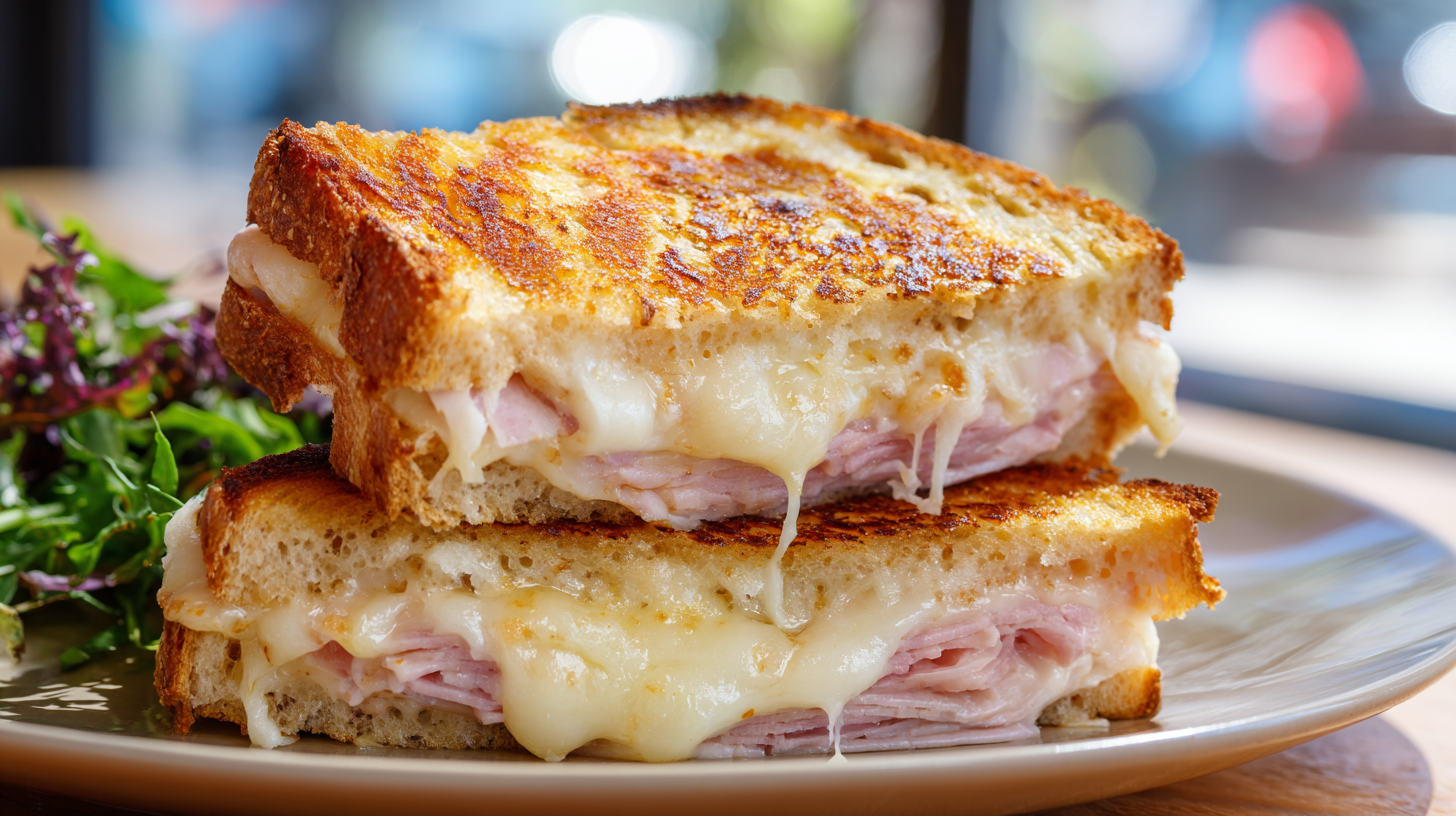
Why this sandwich works in a cafe
Three reasons to put a croque monsieur on the menu.
It is one of the few sandwiches genuinely better in a cafe than at home. The home cook can manage avocado toast, can probably handle a club sandwich, and can certainly throw together a ham and cheese toastie. None of those will be better at a cafe than at home. A proper croque monsieur, with house bechamel and good gruyere, pressed in a commercial sandwich press at the right temperature, requires kit and technique that the home cook does not have. The dish has a structural reason to exist on a cafe menu.
It is technique-honest and prep-friendly. The bechamel batches in advance and holds for two days. The ham and cheese are stable. The bread is a daily order. Service is sub-five minutes from docket to plate. The dish is forgiving on the prep side and consistent on the service side.
It carries a premium price without seeming overpriced. Customers will pay $18 to $22 for a properly executed croque monsieur because the dish reads as substantial and the ingredients (gruyere especially) are recognisably premium. The same customer would baulk at $18 for a ham and cheese toastie. The croque monsieur framing earns the price point.
The bechamel is the whole game
The technique that separates a great croque monsieur from a forgettable one is the bechamel. Most cafes, when they attempt the dish, treat the bechamel as an afterthought. They use too little. They make it too thin. They forget to season it properly. Or worse, they skip it altogether and just pile on extra cheese.
The bechamel does three things in the sandwich.
It carries fat into the bread, so the toast cooks crisp on the outside and stays tender on the inside. Without bechamel, the bread either burns or stays soft, depending on the press setting.
It binds the cheese, so the gruyere melts into a sheet rather than pulling apart in greasy strings. Without bechamel, the cheese behaves like cheese on a normal toastie: hot, stringy, and inconsistent.
It carries the seasoning. A bechamel salted properly with a hint of nutmeg gives the sandwich its signature character. Without that seasoning, the dish reads as bland regardless of how good the ham and cheese are.
The bechamel itself is straightforward: equal parts butter and flour cooked into a roux, warm milk whisked in gradually, simmered to a coating consistency, seasoned with salt, white pepper and a small amount of fresh nutmeg. Roughly 100 grams per portion, spread generously across the inside of both bread slices before the ham and cheese go in.
Bechamel made the day before reheats badly straight from the fridge. The starch sets and the texture goes paste-like. Reheat gently with a splash of milk, whisking continuously, to bring it back to spreadable consistency. Do this every morning before service rather than holding pre-made bechamel for multiple days.
Why gruyere is non-negotiable
The classic croque monsieur uses gruyere. Substituting cheddar, tasty cheese, or mozzarella does not produce a worse croque monsieur. It produces a different sandwich entirely.
Gruyere has three properties that make it the right cheese for the dish. It melts cleanly without becoming oily. It has a nutty, slightly funky depth that pairs with the smoky ham and the rich bechamel. And it has structural integrity when sliced (it can be cut to thickness and laid flat, rather than crumbling or grating into uneven mounds).
Comte is an acceptable substitute, with similar melt behaviour and a slightly milder flavour. Emmental works but reads as more neutral. Cheddar is the wrong cheese: too sharp, too oily on the melt, and it changes the dish into a more familiar Australian toastie that customers will not pay $20 for.
Yes, gruyere is expensive. It runs around $50 to $70 a kilogram wholesale, which makes it the single largest food cost line on the dish. Cost it correctly and the dish still works at 25 to 30 percent food cost. Cut corners on the cheese to drive food cost down to 20 percent and the dish stops being worth ordering.
Three to four minutes at 180 degrees
The cooking is the simplest part of the dish, and also the part where the temptation is to leave it in too long. Sandwich press at 180 degrees Celsius for three to four minutes. The outside should be deep golden, the cheese should be visibly melted at the edges, and the bechamel should have warmed through without separating.
Five minutes is too long. The bread starts to burn before the centre is properly hot. Two minutes is too short. The cheese has not melted and the bechamel is still cold in the middle. The window is narrow but it is consistent: 180 degrees, three to four minutes, every time.
The case for the croque monsieur
The croque monsieur is one of the strongest sandwiches a cafe can put on the menu. It is technique-honest, prep-friendly, premium-priced, and the bechamel detail is what separates a great version from a forgettable one. For the cafes that want a hot sandwich on the menu that feels substantial without being heavy, that customers will pay properly for, and that the kitchen can deliver consistently at service speed, this is the dish.
It is also a dish that respects the customer. The ingredients are honest, the price reflects the value, and the technique behind it is real cooking rather than assembly. In a cafe market crowded with sandwiches that feel interchangeable, that matters.