
Warm grain instead of cold leaves
The defining decision of the bowl format is the base. Where a salad starts with mixed leaves, a bowl starts with a grain or legume: lentils, quinoa, brown rice, farro, barley, or sometimes a combination. The base is warm or room temperature. It is filling. It carries the dressing well. And it does not wilt.
Lentils are the working default for vegetarian bowls. They are cheap (around $4 to $6 per kilogram dried, yielding 2.5 times their weight cooked), they carry flavour beautifully, they are protein-dense, and they pair with almost any vegetable or cheese. A 150-gram portion of cooked lentils is the substantial heart of the dish, the part that fills the customer rather than just garnishing the bowl.
The decision to dress the lentils while warm is the small detail that separates a great bowl from a flat one. Warm lentils absorb vinaigrette evenly and the flavour develops as they cool to plating temperature. Cold-dressed lentils stay bland because the dressing sits on the surface rather than penetrating.
Layer for visual variety, not chaos
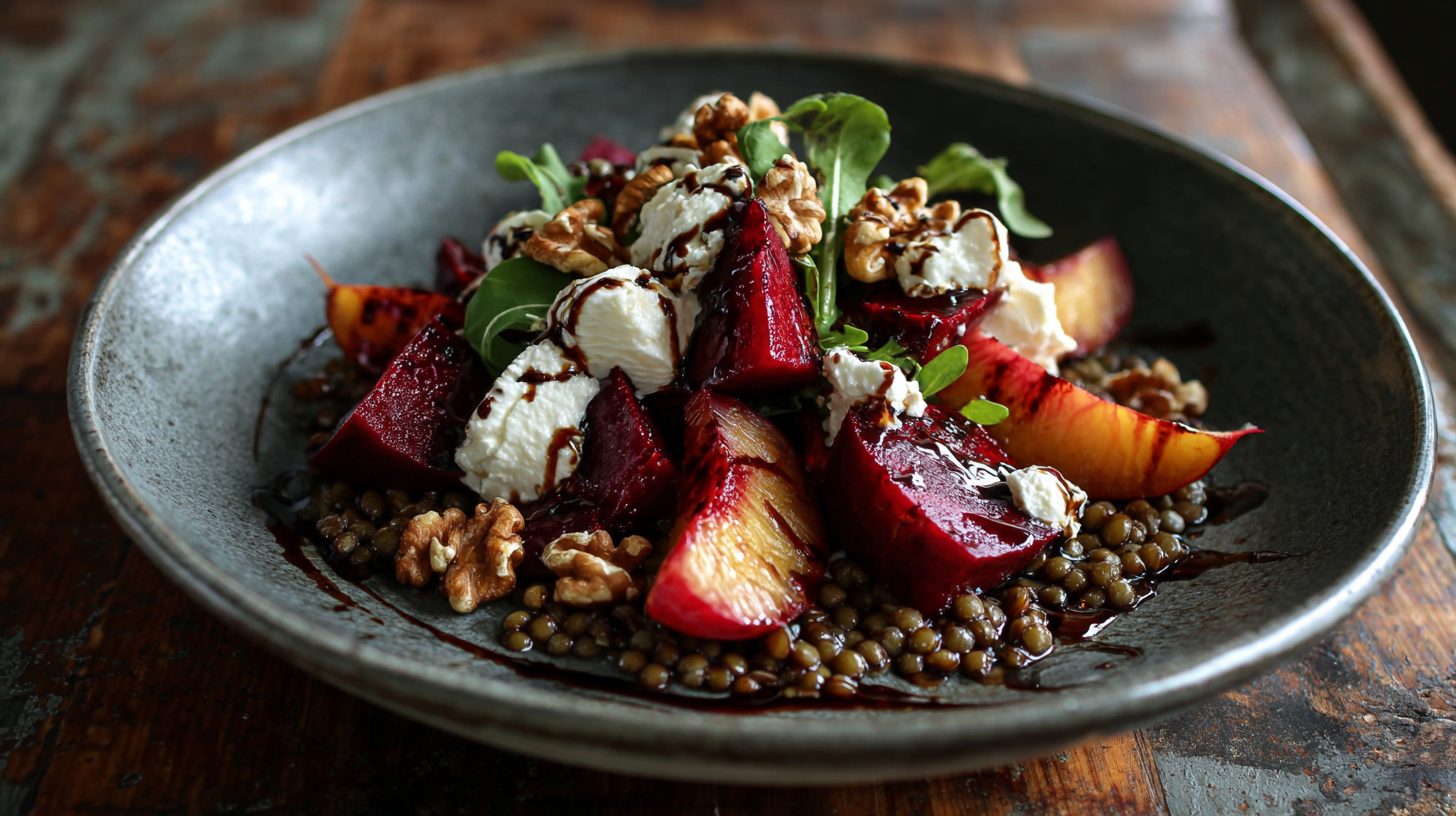
The visual appeal of a bowl is in its architecture. Each component is placed deliberately rather than tossed together. The lentils form the base. A handful of greens (rocket, spinach, watercress) is arranged to one side. Roasted or grilled vegetables take a third of the surface. Soft cheese is crumbled in clusters rather than scattered evenly. Nuts go on top for crunch. The dressing is drizzled.
The customer sees the bowl, identifies the components at a glance, and chooses how to combine them. This is different from a salad, where everything is dressed together and the customer eats whatever the fork picks up. The bowl format invites participation. The customer has agency over each bite.
The bowl reads best when it has architecture. Six toppings randomly distributed with dressing dumped over the top reads as visually busy and texturally uniform. A great bowl uses three to five components, placed in distinct zones, with clear contrast between them.
Temperature, texture, and flavour all need to vary
Three contrasts decide whether a bowl is satisfying or monotonous.
Temperature contrast. Warm grain base, cool soft cheese, room-temperature roasted vegetables, slightly warm grilled fruit. The mix of temperatures is what makes the dish feel alive in the mouth. A fully-cold bowl reads as a salad. A fully-warm bowl reads as a stew. The contrast is the dish.
Texture contrast. Soft lentils, crisp leaves, tender roasted vegetables, crunchy nuts, creamy cheese. The customer's mouth notices every transition. A bowl with all soft components reads as baby food. A bowl with all crunchy components reads as exhausting. Three to four texture layers is the working range.
Flavour contrast. Earthy lentils, sweet roasted beetroot, peppery rocket, tangy goat cheese, bitter walnuts, bright lemon dressing. Each bite combines two or three of these. The customer never gets bored because no two bites are identical. A bowl with one dominant flavour profile (all earthy, all sweet, all tangy) gets samey by the third bite.
The classic example of all three contrasts working together is the beetroot, lentil and goat cheese bowl. Warm dressed lentils (warm, soft, earthy). Cool crumbled goat cheese (cold, creamy, tangy). Roasted beetroot wedges (warm, tender, sweet). Grilled peach (warm, soft, sweet-acidic). Rocket leaves (cold, crisp, peppery). Toasted walnuts (room temp, crunchy, bitter). Six components, three contrasts on every axis, and the dish reads as deliberate rather than crowded.
Everything in advance, assembly to order
The commercial advantage of the bowl format over a salad is that bowls assemble fast at service. The grain base is cooked in advance. The roasted vegetables are batched. The dressing is jarred. The nuts are toasted and stored. The cheese is portioned. At service, the cook spoons the warm base into the bowl, places three or four components, drizzles the dressing, and sends the dish in 90 seconds.
A salad is harder to prep ahead. Pre-dressed leaves wilt within an hour. Pre-mixed salads lose their structure. So the salad cook is doing significant work at every order, which slows service and increases the chance of inconsistency.
The bowl is structurally a better cafe item. Faster at the pass, more consistent across plates, easier to manage prep waste, and it holds its visual appeal through a long service.
Bowls beat salads on every cafe metric
The cafe bowl outperforms the cafe salad on the metrics that matter to the operator: it is more satisfying for the customer, it has a better food cost profile, it assembles faster at service, it holds its appeal through a long display, and it positions as a more substantial meal at a higher price point.
A cafe with three salads on the lunch menu and no bowls is leaving money on the table. Replacing one salad with a properly-built bowl (warm grain base, three to five components in distinct zones, three contrasts on temperature, texture and flavour) is one of the highest-ROI menu changes a cafe can make.
The shape of the dish is not just aesthetic. It is operational. Bowls work where salads do not, and the cafes serving them well are quietly winning the lunch service.